



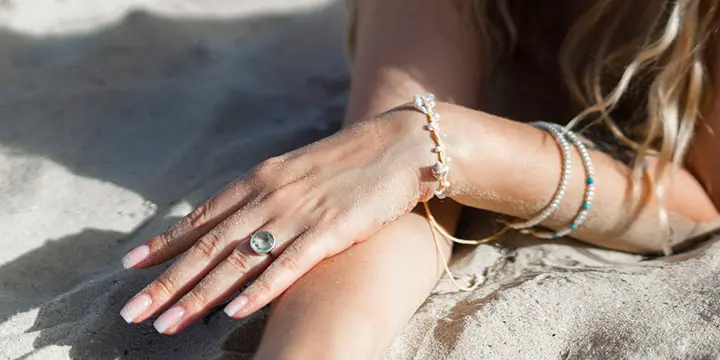
There’s nothing quite like the feeling of sand between your toes, warm sun on your skin and your favorite jewelry sparkling in the light as you stroll down the Boardwalk. Whether you’re packing for a beach day or planning a seaside wedding, you want your pieces to shine from sunrise to sunset.
Before you head to the shore, you should be aware of how saltwater, waves, salty air and sand can affect your favorite pieces. Some metals tarnish, rings can slip off in the surf and tiny grains of sand can scratch softer gemstones.
To help you look stylish on the Boardwalk while protecting your jewelry, this guide covers what you need to know before wearing jewelry to the beach. You’ll learn what’s safe to wear in the water, what works for a beach wedding and how to care for your pieces after a day by the shore.
If you plan to take a dip in the surf, you need to know which jewelry pieces can handle the water and which ones should stay safely in your beach bag. The ocean can affect jewelry in ways you might not expect, and a few well-considered choices will protect your beautiful pieces throughout your trip.
Picture this — you’re waist-deep in the waves, soaking up the sun, only to glance down and see your favorite gold bracelet looking duller than it did an hour ago.
Pure gold won’t react with the salty ocean, but many gold jewelry pieces are alloys made with copper, zinc and nickel. While those additions make 10-karat, 14-karat and 18-karat gold possible, they also make your jewelry vulnerable to saltwater, which triggers tarnishing and corrosion.
Blue gold, which often includes iron, and rose gold, which gets its warm pink shade from copper, need extra care around saltwater. These metals can react with ocean water and lose their luster after a few swims in the waves.
For ocean wear, choose materials such as 18-karat gold and above, gold-filled jewelry, platinum and titanium. These options resist corrosion better than lower-karat gold. Even so, saltwater can still weaken gemstone settings over time, so save pieces with prongs or set stones for dry land.
Remember these safety tips before swimming with gold jewelry.
When you come up for air after a cool dip in the Atlantic, you notice your ring is missing. It fit perfectly this morning, yet it’s now gone somewhere in the sand and surf.
Your blood vessels constrict in response to cold water, redirecting blood flow to protect your organs. This process, called vasoconstriction, causes your extremities to shrink. Your fingers get smaller, and a ring that felt snug on dry land can slip right off before you notice.
Waves may also cause you to lose your jewelry. An unexpected swell can snap a thin chain or pull off a delicate necklace in seconds. Unbacked earrings can fall out when you duck underwater or shake water from your hair.
Follow these simple precautions before getting in the water to avoid losing your jewelry while swimming.
You’re wading in shallow water when you feel a nudge against your ankle. Then another. You look down and catch something darting past your bracelet.
Fish and other sea creatures are naturally curious, and underwater, shiny jewelry can look a lot like their usual prey. Metallic surfaces catch and reflect light in ways that mimic the scales of small fish, making your bracelet seem worth investigating.
The good news is that these encounters are almost always harmless. Most ocean animals lose interest the moment they realize you’re not food, but the experience can still be so startling that you wish you’d left the bling on your beach towel.
Choose jewelry that won’t attract extra attention in the ocean.
Even if you never take a dip in the ocean, the salt in the air near the beach is enough to dull some metals over time. That’s where waterproof anti-tarnish jewelry comes in. These pieces resist tarnishing, corrosion and discoloration from saltwater, humidity and salt air. Some use durable metals, while others have specific coatings to withstand coastal elements.
Waterproof anti-tarnish jewelry is a worthy investment for your vacation wardrobe if you plan to spend a long weekend at the beach. Look for materials that can handle salt, humidity and sun.
How can you look your best on the beach without constantly worrying about your jewelry? The secret is choosing pieces that can handle sun, surf, sand and salt air without losing their shine.
Start by selecting fun, easy-to-remove pieces that you won’t mind taking off for a quick swim. These should be items you feel comfortable wearing, removing and storing between activities throughout the day. If you bring pieces you’d like to wear for photos, add a small travel case to your beach vacation packing list so you have a safe place to put them.
Here’s another tip — delicate jewelry is your friend at the beach. Chunky styles can leave awkward tan lines, while slim chains and lightweight pieces let you tan evenly while still looking polished.
Plain, no-frills pieces are usually best for the beach. Thin chains made from solid gold, gold-filled materials or stainless steel are durable, salt-resistant and won’t snag on your swimsuit.
Pay attention to the clasp. Styles that open easily are more likely to pop open while swimming or if a wave catches you by surprise. Look for secure closures that can handle wave action without coming undone.
If your necklace has a pendant, especially one with gemstones, keep it out of the water. Pieces with set stones are better for photos, dinner or Boardwalk strolls than swimming.
Focus on simple styles and secure details for necklaces that can handle a beach day.

The best beach bracelets can handle a full beach day and still look flattering. Slim bangles, cuff-style bracelets and simple chain bracelets in stainless steel, solid gold or gold-filled materials are ideal. They’re durable, resist corrosion and won’t trap sand the way more intricate styles do.
Charm bracelets and heavily linked designs might look adorable, but they can be tricky at the beach. Sand gets into every crevice, and those tiny quartz grains act like sandpaper. Quartz sits at 7 on the Mohs hardness scale, which means it’s hard enough to scratch softer metals and accelerate wear.
Stick with simple, secure beach bracelets with secure clasps or slide-on styles that won’t pop open mid-swim.
Some styles need extra protection from beach conditions. Sand often contains quartz, which can scratch soft stones and metals. Gems like diamonds, rubies, sapphires and topaz that rank 8 or higher on the Mohs hardness scale can resist sand abrasion, but softer stones won’t fare as well.
Porous gemstones are especially vulnerable. Opals, turquoise, amber and pearls absorb moisture from saltwater and salt air, leading to discoloration, cracking and permanent damage.
Keep valuable or sentimental pieces at home or in your hotel safe during beach outings. Bring a small travel case where you can tuck them safely away before heading down to the water, then retrieve them to wear to your post-beach dinner.
And remember, delicate jewelry creates softer tan lines than chunky statement pieces. Keep your beach jewelry light and minimal if you want an even tan by the end of your trip.
Ocean County alone hosted 3,311 weddings in 2025. If you plan to join those happy couples, explore local beach wedding options and tips for planning a beach wedding in Ocean City.
When tying the knot with your feet in the sand, you want jewelry that can handle the elements without losing its sparkle. The best jewelry for a beach wedding combines durability with elegance. Here’s what works.
Choose wedding jewelry that looks elegant while standing up to coastal conditions.
After a day in the sun, sand and salt air, your beach jewelry needs extra TLC to get it in good shape for your next outing. The good news is that it only takes a few minutes to keep these pieces looking their best.

Ocean City knows how to help our visitors maximize every sun-soaked moment. From morning swims and Boardwalk strolls to breathtaking beach weddings, this is a place where you can truly relax and enjoy the coastline without worrying about the little details.
Now that you know how to protect your jewelry while you’re here, it’s time to plan the rest of your trip. Whether you’re packing for a family vacation, prepping for your big day by the water or just looking for ways to make your beach experience even better, we’ve got you covered. Explore our beach trip tips and hacks for clever ways to streamline your day at the shore.
Ocean City is waiting, and we can’t wait to see you shine.